A Christmas Carol: five staves instead of chapters
Published
How Dickens writes a carol in five staves
The book is not in chapters but in five staves, like the verses of a carol. Marley's ghost comes first, then one stave for each of the three spirits, then the end.
Stave III, the spirit of Christmas Present, is the longest: 29% of the book's 28,583 words, a stave's share being its words, from its heading to the next, over the book's words in the Project Gutenberg text. Stave I is 23%, Stave II 22%, Stave IV 19%; Stave V, the end, is 8%. Drawn as one bar per stave, the middle bar is the widest; the last bar is 8% of the whole.
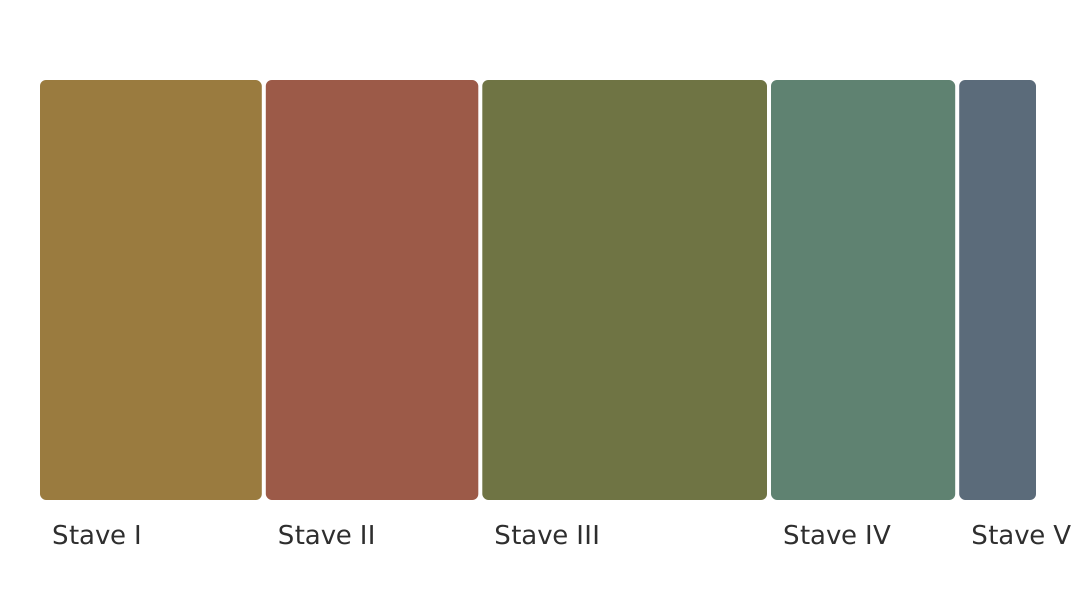
Illustration drawn from the Project Gutenberg text, each stave's length counted in words; the five staves after Philip V. Allingham (Victorian Web). Not a Scrin screen.
What it offers someone writing now
A book can borrow its shape from another form, a song in verses rather than a story in chapters. Allingham, on the Victorian Web (2003), keeps the word staves for its parts. Count the words of each part of a manuscript, from its heading to the next, and write each part's share of the whole beside its name: the part that carries the most, and the one that is shortest, are then read off the list, and a bar drawn to each share shows them at a glance.
The analysis behind it
Philip V. Allingham, the Victorian Web (2003), on the novel's division into five staves rather than chapters. https://victorianweb.org/authors/dickens/xmas/pva13.html
The text: Project Gutenberg #46.
See your own manuscript this way
Scrin is a home where pages grow into books: you keep writing, from an untitled line to a chapter, and Scrin keeps the rest.
Import a manuscript and Scrin gives it back as a book you can read differently: its plan, the length of every chapter, and what keeps coming back.