Frankenstein: three narrators, one inside another
Published
How Shelley keeps three voices apart
Walton writes letters; inside them, Victor tells his story; inside Victor's, the creature tells his. The counts on this page were made by Scrin for this page in October 2026, in the Project Gutenberg plain-text edition, #84, from the ebook's start marker to its end marker, so the title page and contents are included: 67 words before Letter 1, in a book of 75,087. A chapter's length runs from its heading to the next heading, and a word is a word as Unicode word segmentation counts it, a run of letters or digits, a hyphenated word counting once. A position is the share of the book's words that come before it. The four letters are 5,545 words, 7% of the book. The creature's own account runs from chapter 11 to chapter 16, from 41% to 62% of the words, 20% of them. By the same count, the parts run from 299 words, Letter 3, to 8,244, chapter 24.
By the same count, chapter by chapter, a chapter counting when the name appears in it at least once, Walton is named in letters 1, 2 and 4 and in the last chapter, 24, nowhere else. The De Lacey family, Felix, Agatha and Safie, is named only in chapters 12 to 16, at the centre; Felix and Safie come back once in the last chapter, where Walton mentions “the letters of Felix and Safie”. Drawn as one bar per chapter, with the speaker laid over the bars, the voices sit in bands: the outer one at both ends, the inner one in the middle.
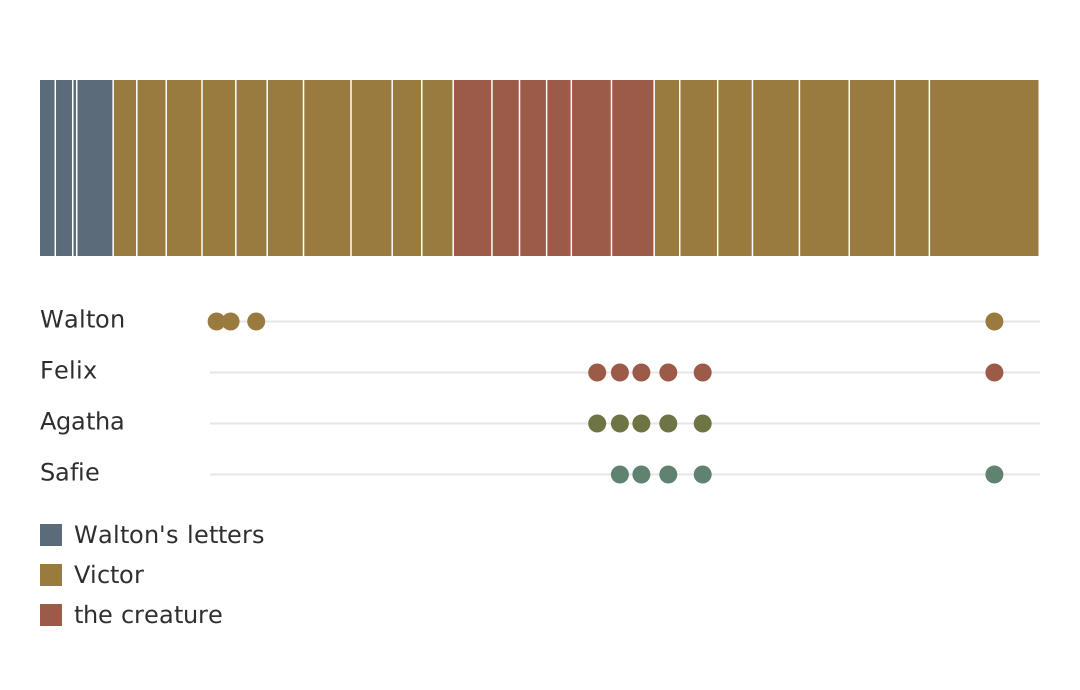
Illustration drawn from the chapter lengths, in words, counted for this page, October 2026, in Project Gutenberg #84, a chapter's length being its words from its heading to the next; who is speaking after Joyce Zonana (1991). Not a Scrin screen.
What it offers someone writing now
A novel can hand its telling from one voice to another and back, each voice holding what the one outside it cannot. Zonana places a set of letters at the very centre of these nested narratives. Mark, chapter by chapter, which voice is telling and inside whose account it sits; count each voice's words; draw one bar per chapter, coloured by its voice; then read where an inner voice opens and closes and how much of the book it holds. Who is speaking in each chapter is then a shape a writer can look at whole.
The analysis behind it
Joyce Zonana, Journal of Narrative Technique (1991), on Safie's letters: “At the very center of the concentric narratives” of the novel. https://knarf.english.upenn.edu/Articles/zonana.html
The text: Project Gutenberg #84.
See your own manuscript this way
Scrin is a home where pages grow into books: you keep writing, from an untitled line to a chapter, and Scrin keeps the rest.
Import a manuscript and Scrin gives it back as a book you can read differently: its plan, the length of every chapter, and what keeps coming back.