Jane Eyre: five places, five acts in Martin's reading
Published
How Charlotte Brontë moves Jane through five places
The book has 38 chapters and five places under six names, places that Robert B. Martin (1966) reads as five acts. Marsh End and Moor House are two names for one house, said in chapter 29: “Some calls it Marsh End, and some calls it Moor House.” The counts on this page were made by Scrin for this page in October 2026, in the Project Gutenberg plain-text edition, #1260, from the ebook's start marker to its end marker, so everything before chapter I is included, 948 words in a book of 187,095; a chapter's length runs from its heading to the next heading, from 1,828 words, chapter 38, to 11,239, chapter 27; a word is a word as Unicode word segmentation counts it, a run of letters or digits, a hyphenated word counting once. By the same count, chapter by chapter, a chapter counting when the place's full name appears in it at least once, each name keeps mostly to one stretch. Gateshead is named in chapters 2, 3, 4, 5, 7, 8 and 10, then in 21, 22, 27 and 33. Lowood is named in 4 to 11, 13 and 14, then in 21, 22, 24, 25, 29 and 33. Thornfield is named in 10 to 13, 15 to 18 and 20 to 27, then in 33, 36 and 37.
Marsh End is named in 28, 29 and 30; Moor House in 29, 30, 31, 33, 34, 36, 37 and 38; Ferndean in 26, 27, 36 and 37, in 26 and 27 as Rochester's other house, before the story goes there. Drawn as one bar per chapter, with one row per name laid over the bars, each name holds a stretch of the book, and the stretches overlap at their edges. Jane leaves Gateshead for Lowood in chapter 5; the name Gateshead is still printed in chapter 33, in memory and talk.
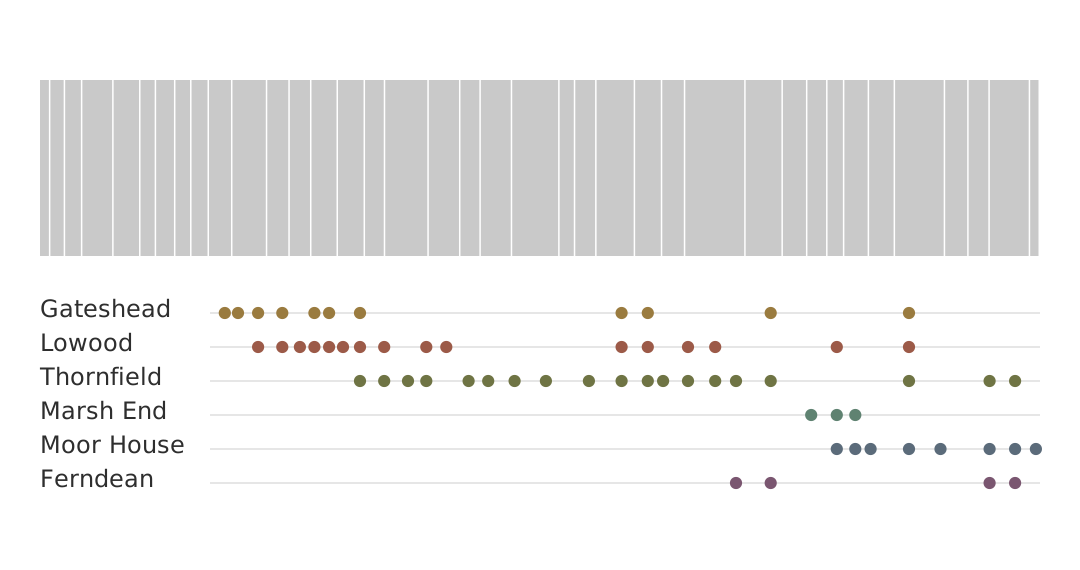
Illustration drawn from the chapter lengths, in words, counted for this page, October 2026, in Project Gutenberg #1260, a chapter's length being its words from its heading to the next; the chapters where each of the six names appears counted the same way, one row per name; the five places read as five acts after Robert B. Martin (1966, quoted on the Victorian Web). Not a Scrin screen.
What it offers someone writing now
A novel can let place do the work of structure, each setting carrying one stage of the story. Martin reads the book as carefully divided into five locales, each like an act. Count where each place of a manuscript is named, chapter by chapter: a name that keeps to one stretch marks a stage, and a name that comes back shows what the story carries forward.
The analysis behind it
Robert B. Martin, Charlotte Brontë's Novels: The Accents of Persuasion (1966), quoted on the Victorian Web: the novel is “carefully divided into five distinct locales”, “each of which is like an act in a five-act drama”. https://victorianweb.org/authors/bronte/cbronte/je1.html
The text: Project Gutenberg #1260.
See your own manuscript this way
Scrin is a home where pages grow into books: you keep writing, from an untitled line to a chapter, and Scrin keeps the rest.
Import a manuscript and Scrin gives it back as a book you can read differently: its plan, the length of every chapter, and what keeps coming back.